 |

 |
There is little of the spit-and-polish soldier in Claire Chennault.If he struts, it is because he has a tense spine, bowed legs and a bitter spirit.During the Flying Tigers' early battles, when he was both studying and teaching tactics, he would go up into the control tower at Toungoo field dressed in a pair of shorts,a short-sleeved white shirt and a battered felt hat, and he would dictate to a stenographer his comments on each pilot's way of fighting.Later he would sit down with each man, like a colleague rather than a commander, and would rub out the soft spots and help make another perfect fighter.
This informal soldier is bitter because he has always had to fight for what he believed.As a young man he was appointed teacher in the toughest school in backwoods Louisiana.He believed in discipline and whenever the big Athens boys got obstreperous, Chennault asked them to step out into the yard.Soon order came to the school.
When he first applied for flight training, he was turned down with the comment: "Does not possess necessary qualifications to be a successful aviator."But within three months he had fought his way to acceptance.
As a military man, he has consistently gone to bat for the men of his command - but he has also fought against them when it seemed right.When 30 of his 34 AVG pilots handed in resignations in April 1942, because they felt they were being expended needlessly by Chennault, he called them in and said: "Under the Articles of War, the punishment for desertion in the face of the enemy is death.Think it over." They did.
His great work has been his fight for fighters - as opposed to bombers.He was the Billy Mitchell of pursuit.But his deafness made him resign from the Army in 1937, and it was not till he went to China as aviation adviser to the Chiangs and later formed the AVG that his theories proved themselves.Now the Army has taken him back and, whether they know it or not, fighter pilots all over the world learn Claire Chennault's bitter lessons.They learn the three basic Chennault rules:
Be flexible. Chennault taught his Flying Tigers one set of tactics when they opposed the Zero with the heavy P-40 - essentially dive, squirt, pass, run. But he said: "If we had Zeros we would change our tactics and beat the Japs flying P-40s." And he would.
Be a team. Chennault's Men on a Flying Trapeze were such a team that they could tie their planes together with short lengths of string, take off, go through brazen maneuvers and land with the strings unbroken.In war Chennault devised the two-plane element rather than the V of three as the most efficient team.
Know your strength. In the bamboo barracks at Toungoo he would say: "Each type of plane has its strong points and weaknesses.The pilot who can turn his advantages against the enemy's weakness will win every time."Chennault used pencil and paper, blackboard and chalk, persuasion and the graceful hand movements of a pilot talking about planes to show his men their peculiar strengths and the enemy's weaknesses.
He fought the Army to put increased firepower in their two-gun fighters, but they would not give way until the Russians came out in Spain with four fixed guns firing synchronously through the shirring propeller.He fought for fighters dropping "frag" bombs on bombers.He fought for paratroopers, for more emphasis on marksmanship, for better warning systems in days before radar.
Like all really good fighters, Claire Chennault has a warm, gentle core.There was no rank in his AVG; there is no authority except excellence in his Fourteenth Air Force.He has seven children of his own, but Chinese poverty so moved him that he adopted several Chinese orphans.He is a good teacher because, having had a bitter fight in life himself, he is sensitive to other people's troubles.
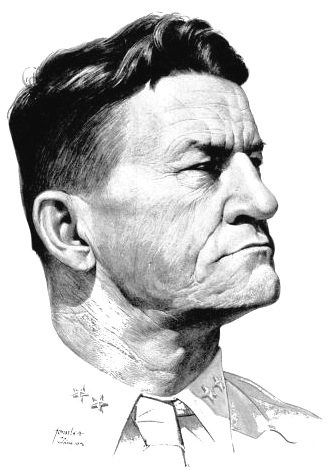
But he is pugnacious, too, and he certainly looks it.One of his men was asked one day to describe his face."He looks," the flier said, "as if he'd been holding his face out of a cockpit into a storm for years."The flier should have added that he was holding it out there to look for someone in the storm to fight with.

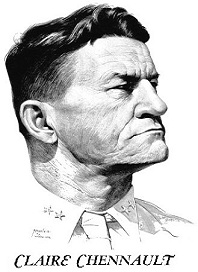
Story by John Hersey • Drawings by Tom Lea
from "Three Airmen" in the May 29, 1944 issue of LIFE. Portions copyright 1944 Time Inc.
FOR PRIVATE NON-COMMERCIAL HISTORICAL REFERENCE ONLY
TOP OF PAGE ABOUT THIS PAGE MORE LIFE IN CBI CLOSE THIS WINDOW
VISITORS