|
|
Though it gets small space in the U.S. press, the war in China, now in its fourth year,
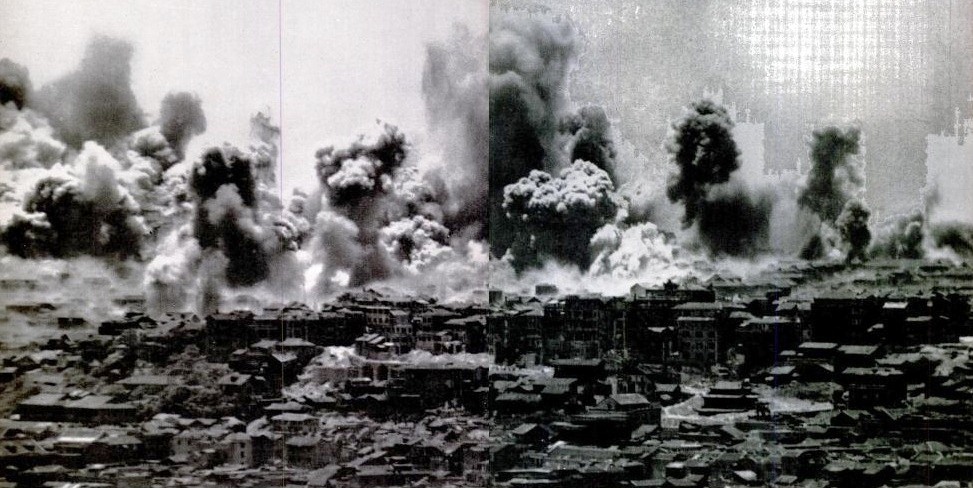
still goes on and now and then produces a picture like that above, which for sheer spectacular terror matches anything out of Europe.
The scene is Chungking, capital of free China, the date is June 28 and the occasion is a Japanese air raid as seen from Horse Saddle Mountain
across the Yangtze after three hours of high-explosive bombing by 86 enemy planes.
A mountain of smoke and dust rises over flimsy wood and plaster buildings of the "Old City" at the top of the hill.
Flames sweep like a wild surf over whole sections.
On the steppingstones that serve as streets, scores lie dead and wounded.
Some 100 shops and 1,000 buildings have been damaged.
Universities, schools, hospitals, U.S. missions and the British Embassy are hit.
It is Chungking's fifth battering in as many days.
Yet it is no record-breaker for this sort of thing.
Generalissimo Chiang Kai-shek's troops are able to put up practically no defense against such Japanese attacks.
Yet Chungking survives.
Since he and his government moved there in 1938, the city has boomed despite frequent bombings.
Over 190 miles of new wide streets have been built.
New buildings of stone have replaced the bombed wooden ones.
In the suburbs small factories and arms works, hauled overland by the Chinese retreating from Shanghai to Nanking and from Nanking to Chungking, are in production.
The population has risen to 420,000 people, 250,000 of whom are already safe from air attack in shelters that have been cut deep in underground rock.
One rock shelter cuts under the main downtown section of the city for half a mile.
While the Japanese raze the wooden surface of an old city, Chinese are busy putting up the stone framework of a new city.
CLOSE THIS WINDOW
|
|