|
|
 Across the face of Asia from the military cul-de-sac at Vladivostok to the monsoon-protected waters
of the bay of Bengal, Russians, Chinese, Britons, Americans and Indians are today waiting in a state of
nervous tension for the next move of a Japanese military machine that has so far proven itself superior
in almost all branches of warfare in the Far east.
Across the face of Asia from the military cul-de-sac at Vladivostok to the monsoon-protected waters
of the bay of Bengal, Russians, Chinese, Britons, Americans and Indians are today waiting in a state of
nervous tension for the next move of a Japanese military machine that has so far proven itself superior
in almost all branches of warfare in the Far east.
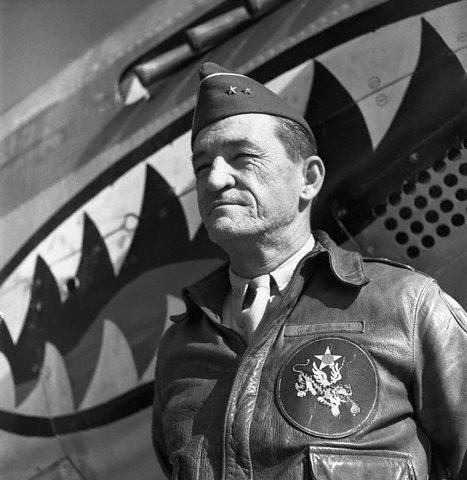
Acutely aware of the contradictory needs of members of the United Nations, U.S. Brigadier General Claire L. Chennault, newly appointed commander in chief of the China Task Force, has vaulted over all theoretical barriers to throw a small group of American pursuit and bomber pilots into the battle, to hold off, beat back and weaken the numerically superior Japanese aerial armada pouring back from conquests in the Southern Pacific to bases in China. Chennault, with newly arrived American Army bombers and veteran pilots of his own disbanded American Volunteer Group, carried the attack directly against Japan's main air bases in China. Six times within five days Chennault threw his aerial guerrillas against Jap planes at Hankow, Canton, Nanchang, bombed ships on the Yangtze, blew up warehouses, docks and factories, strafed Jap ground troops in the eastern provinces of China and assaulted Jap Army Headquarters in Kiangsi. Since assuming his new command late in June, Chennault has pushed his aerial outposts close up against Jap bases, advanced his subsidiary bases, driven the Japs out of the skies in Hunan, Kiangsi and Yunnan, and pushed back their areas of operations in Kwangtung and Kiangsi.
In the past two months he has rid Hengyang, Kweilin and thousands of towns and villages about the Canton-
Hankow Railway of dread aerial bombings.
He has eliminated the barbarous Jap practice of using the Chinese
people as human guinea pigs for training raw pilots.
He has changed the living conditions and habits of
thousands of Chinese in towns in southwest China, and once more people reopen their shops and dare to do
business in daylight hours.
He has been presented with dozens of presents, banners and trophies from
grateful Chinese.
Beautiful Chinese girls, escaped from Hong Kong, have attended parties to express
admiration and gratitude to the hard living American pilots.
And he and his boys have done more to make
the Chinese believe in American sympathy and help than a hundred Roosevelt's speeches.
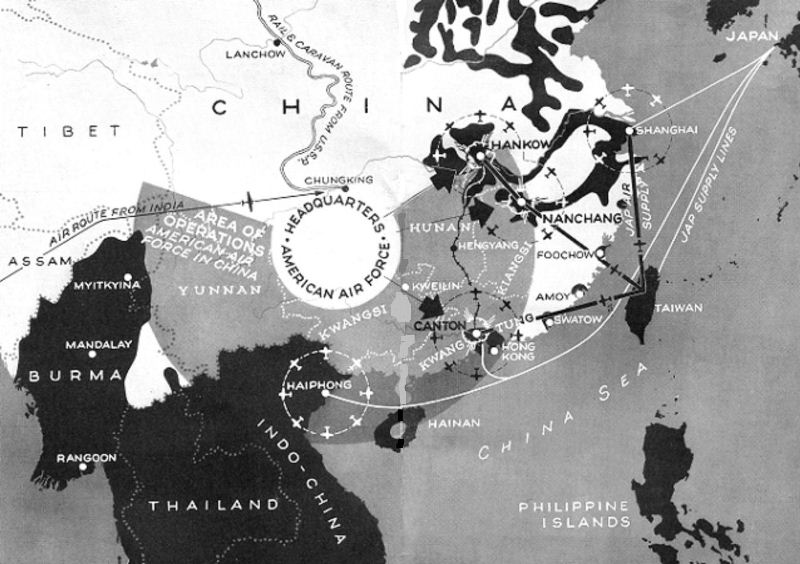 Based in the heart of China, Gen. Chennault's fliers can operate over a wide segment of eastern Asia,
partly under enemy control.
Arrows show July raids on Jap bases to northeast and along the coast.
Supply problem is tough.
Japs have all important coastal ports from Shanghai to Haiphong as terminals
for supplies sent from Taiwan, whereas Americans rely on single air route from India, which crosses some
of the world's most rugged terrain.
Based in the heart of China, Gen. Chennault's fliers can operate over a wide segment of eastern Asia,
partly under enemy control.
Arrows show July raids on Jap bases to northeast and along the coast.
Supply problem is tough.
Japs have all important coastal ports from Shanghai to Haiphong as terminals
for supplies sent from Taiwan, whereas Americans rely on single air route from India, which crosses some
of the world's most rugged terrain.
|
Within the last month Chennault has cleared the air for safe passage of transport and passenger planes. Six weeks ago, pilots took off from China airdromes at dawn and arrived at dusk on what, in their own words, was a "helluva dangerous flight." But today big transports, carrying war materials, medicines and military personnel, fly at any time of day in perfect safety within one hour's flying time of any Jap pursuit from any direction.
How long this state of affairs will last is problematic. The Japanese air force in China is vastly superior numerically. It has greater facilities for training, supply, equipment and transport, and finally it occupies a position that is geographically superior to Chennault's. Using Formosa as a pivotal base, the Japs can shift large air squadrons either south to Canton and Indo-China or north to Shanghai and Hankow. Through great ports on the seaboard, the Japs can transport gasoline, spare parts, ammunition, bombs and all necessary supplies with minimum difficulty. On the great arc from Hankow through Nanchang to Canton and Haiphong they can shift planes at will, scatter them on numerous subsidiary airfields and make sudden, swift concentrations.
Against all this Chennault has only his own genius, a smattering of Army personnel, remnants of the most brilliant air combat unit the world has ever seen and what heretofore skeptical American Army officials call the best air-raid warning system in existence.
Starting from areas in Free China, in hundreds of small villages, in lonely outposts, in hills and caves, stretching from near Canton through all Free China to the capital in Chungking and to Lanchow, far northwest, are a maze of alarm stations equipped with radios and telephones that give instant warning of the approach of Jap planes. On huge wall maps in air operations' rooms, hundreds of small black circles indicate the location of these stations. And American pilots today watch Chinese liaison officers sticking little red arrows on the maps showing the route of advancing Jap planes. When these arrows indicate the enemy is a certain distance away, motors are turned over and U.S. fighter planes head off to intercept the enemy.
The Chinese, aided by Chennault, perfected this system through five years of war until it is generally recognized as the world's best. It saves thousands of Chinese lives by giving the people time to get to dugouts and is now one of the chief weapons in the hands of the American Air Force.
But even this weapon might not be enough. The Japanese are reliably reported to have concentrated 150 airplanes in Canton. If these come over in waves, Chennault's squadrons might be blasted out of positions by sheer force of numbers. The Japs tried wave bombing in Rangoon and the A.V.G.'s slaughtered them. Yet if mass air assaults fail again, Japan may launch a land drive on Kunming and the Canton-Hankow Railway, take Chennault's chief air base and force him back from his advanced positions.
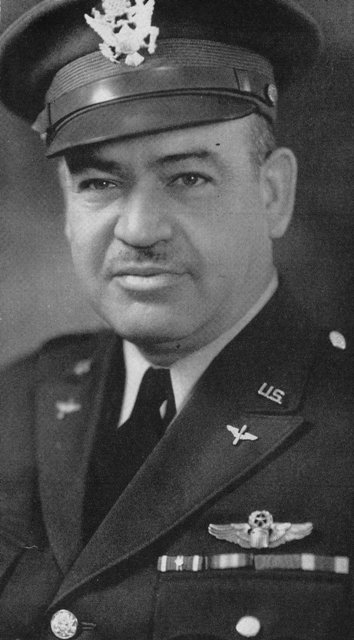 Col. Caleb V. Haynes, a tough, hulking mountaineer, commands Chennault's bomber force.
Jap bases
would be "easy pickings," he says, if Air Force had more bombers.
Col. Caleb V. Haynes, a tough, hulking mountaineer, commands Chennault's bomber force.
Jap bases
would be "easy pickings," he says, if Air Force had more bombers.
|
Already he has gathered to himself two of the most colorful, adventurous and skilful pilots in the world. They are Colonel Caleb V. Haynes, in charge of bomber operations of the China Task Force of the 10th Air Force operating in the China theater of war, and Colonel Robert L. Scott, in charge of all pursuit operations in this theater. Both colonels, like himself, are Southerners. Haynes comes from Mount Airy, N.C.; Scott from Macon, Ga. Both, also like Chennault, are quietly tough, despise the word "can't," eliminate all red tape and allow subordinates full range for individual initiative. Like Chennault, if orders from the above are likely to hamstring operations against the Japs, they go ahead as they please and damn the consequences.
Haynes is a big, hulking mountaineer with the face and simple, careless manner of Wallace Beery. He combines an open frankness with a native cunning. He went to France in 1918 and studied in French flying schools. He has been in the Army ever since. Friends call him one of the best four-motor pilots in the world. He holds the world record for the greatest payload carried to a height of 2,000 meters and the world speed record for 5,000 kilometers with a load of 2,000 kilos.
He opened both the Atlantic ferry service and the southern route from America to Africa and Asia. He made seven Atlantic crossings and says, "I need one to make it even," meaning his return home after the war. He flew the first B-24 bomber from America to Asia. When he set up shop near the jungles in Assam he had formal quarters in a tea plantation consisting of a shed with mud floor on which he and the crews ate under a dim lamp. There were no windows in the shed and the food was execrable. Yet, in the words of a friend, "Within two weeks he had the best mess in India." He set 10,000 coolies to work on a field, which today is one of the most important air bases in India and a jumping-off point for a supply run to China.
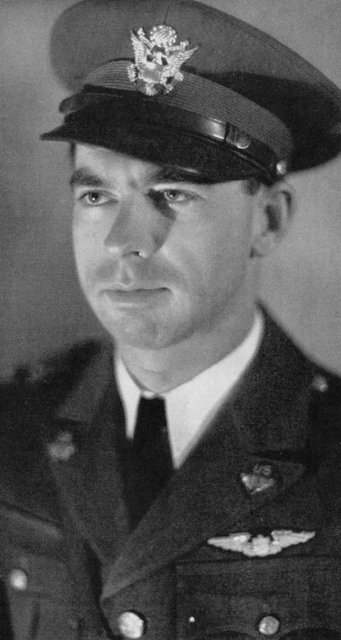 Col. Robert L. Scott, Chennault's commander of pursuit, flew as an ordinary pilot at first to learn
the A.V.G. tactics.
In Burma Scott was known as a one-man air force.
Col. Robert L. Scott, Chennault's commander of pursuit, flew as an ordinary pilot at first to learn
the A.V.G. tactics.
In Burma Scott was known as a one-man air force.
|
Haynes was a pursuit pilot until 1936. He says he used to like pursuits better but now he likes bombers, even though the mental strain is greater because he can't maneuver to fight the attacking enemy. Pursuit flying is romantic and glamorous but Haynes has no idea of glamour. He leads the boys when they are feeling low but otherwise he trusts them to carry out missions themselves so that he can work on a bigger project. A friend says: "He is the only man in the world I ever saw handle a bomber like a pursuit." Though he does not give a damn about playing Army politics, the sheer weight and merit of the man will probably carry him high by the end of the war, or he will be dead.
Colonel Robert L. Scott, commander of pursuits, is probably the most romantic American in China today. Only 34, he might have become one of the youngest generals in the American Army had he not thrown over his prospects for a chance to get at the Japs. A friend told Haynes about Scott's desire to fight as a pilot, a mechanic or anything else, but Haynes was skeptical: "Ain't no such colonel as that." When Scott heard there was going to be fighting he asked no other questions but came along to be the only pursuit pilot at Haynes' ferry command airfield in India. Nine times he flew with the A.V.G.'s on strafing raids and though he was a colonel he flew as a wing man, saying: "I can learn a lot from these boys."
Scott, a fine athlete, came up the hard way, leaving his home in Macon early, bumming around on freighters during vacations. He was naturally adventurous and always wanted to become a soldier. People in Macon got together and insisted he be sent to West Point. He was so wild to go to the front that he could not be restrained. Reckless, flashing, romantic, he is likely to become the D'Artagnan of the air in the Far East. He gives a damn for neither man nor beast, weather nor Japs, and is a regular hell on wings.
Chennault, Haynes and Scott form just about the smartest, don't-give-a-damned-est trio Asia has ever seen. With these two men, Chennault is on the way to forming a staff that can handle anything the Japs throw at him. He still needs a chief of staff, who will likely be an Army officer and not one of his old A.V.G.'s, but for the time being his is operating without one. These men will have under them a combined force of regular Army pilots and those A.V.G.'s who are staying on in U.S. service.
A.V.G. veterans teach new Army fliers
Chennault's force is at present in a state of flux. Many of the best A.V.G. pilots are going back to the U.S. and will have to be replaced. For instance, Bob Neale, a real killer in the A.V.G. who has shot down at least 13 Japs, is at present in charge of all front-line pursuit. After formal disbandment of the A.V.G. on July 4, Neale, like most of the other A.V.G.'s, volunteered for two weeks to help Chennault out. Though a civilian, Neale is thus commanding Army officers.
During this transition period Chennault has placed his A.V.G.'s out on the flanks of air attacks and in front of Army pilots, thus breaking in newcomers slowly. Lots of the Army officers used to be classmates of the A.V.G.'s back in the U.S. and laughed when their friends volunteered to fight in China but today they don't laugh and are eagerly asking and receiving information from A.V.G. veterans.
Army pilots have about the same number of flying hours as the A.V.G.'s but one hour of combat is worth 20 hours of training and the Army has a lot to learn. "They heard so much about us they were inclined to overrate us but the consensus of opinion seems to be that they are tickled to death to fly behind the Tigers," Skipper Adair told me.
All the Army pilots are eager to learn and they've got plenty to learn, as well as unlearn.
Many of them came
out here with ideas of dog fighting the Japs but they are learning there are more important things than this.
The old theories and tactics were for a big formation of pursuits to attack in groups but in combat once the
fight starts, the formation goes all to hell and the A.V.G.'s are teaching the Army men how to fight in a different
way.
The lessons Chennault taught the A.V.G.'s about using the good points of a plane - "Make 'em play your way" -
are being passed on to Army pilots.
Some of the A.V.G.'s who didn't take Chennault's early advice because pride
wouldn't let them dive away from an air fight are today in their graves.
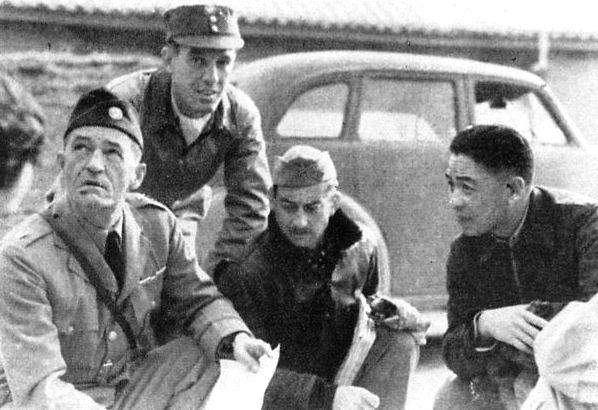 Ex-school teacher General Chennault (left) gives instructions to squadron on patrol duty.
He organized the A.V.G. for Chiang Kai-shek, has been in China since July 1937.
Ex-school teacher General Chennault (left) gives instructions to squadron on patrol duty.
He organized the A.V.G. for Chiang Kai-shek, has been in China since July 1937.
But, principally, green horns have to learn to be cool. The A.V.G.'s already know they can outfight the Japs so they are not nervous, but young Army boys have got to get two or three flights under their belts before they can operate with complete confidence. Naturally they have already made mistakes. One fellow who was nervous got on the tail of a Jap and shot away his ammunition in one long burst, and still didn't get his man. An A.V.G. would have fired a one or two-second burst and it would have been enough. Another newcomer lost his plane because he stuck too closely to Army regulations. He was told one day to put a canopy over his plane. The next day the Japs came over and since he hadn't an order to the contrary he left the plane where it was, instead of flying it off, and the plane was smashed. His heart is broken now but an A.V.G. wouldn't have waited for an order but would have taken up the plane because he knew that Chennault cared less for regulations and obedience than initiative.
But the A.V.G.'s have a lot of respect for the new pilots and one of the best Tigers told me: "If General
Chennault stays in command,
the Army will be just as hot as the A.V.G.'s.
Perhaps their record won't be as good
but they will be just as good pilots."
The hard life - with bedbugs
The young Army pilots are getting along pretty well under conditions entirely different from any they ever
experienced.
I found a squadron living in an adobe hut outside a large town in southwest China.
Their quarters
led off a dining-living room in which the only furniture was two tables put against each other in the form of
a "T" and several hard chairs.
This table, after meals, is used for planning operations.
I didn't see any beds
and learned they were all out in the sun as Chinese mattresses were overrun with bedbugs.
The boys told Chennault
they had trouble with the food and all but three of them had been violently ill the night before when the cook
had used tung oil to cook vegetables.
The General won their hearts when he gave them a pound of butter and two
cans of coffee brought on a transport plane.
They are leading a hard life, arising at 3 in the morning and staying
in the broiling sun under a thatch-covered alert shack on the field until 7 at night.
"We usually rush to the
shower and eat right away so as we can get to bed as quickly as possible,"
one of them told me.
All the members are between the ages of 21 and 28.
Lewis Hay of Donaldson, Ga., the youngest member, who after
graduation from school joined the Army, said he is getting along OK and asked me who is leading in baseball
standing.
John Allison, squadron leader, whom his men claimed as one of the three best pursuiters in the
American Army, came here after a year and a half in England and Russia where he was assembling American planes.
Most of the members of the squadron were students but some were tire salesmen, linotype operators and musicians
before they joined up.
They all like the Chinese. "China is more worth fighting for than any other country in
Asia," said Joe Martinelli.
"This is the best place we have seen since we left America.
It is much better than
India. The people are jolly and damn nice.
They'll really work for you and once you tell them something they
will do it that way until they are killed."
I asked a Chinese cook for the boys what he thought of the Americans. "Hao. They were polite. Thank you when bring them glass of tea."
What worries this squadron more than anything is that they have not yet seen action. "We have nothing to do," says Martinelli. "The A.V.G.'s are on either side and we are in back. We want to get in and fight. We figure the sooner we fight the sooner the war is over. But the Japs are so damned scared of the A.V.G.'s they won't come over. But when they do, we're ready to swallow them." Just before they left India the boys chipped together and bought four bottles of whisky to go to the pilot, crew chief, gunner and radio-man of the plane that shoots down the first Jap.
The problem of forming an air force in China that will lick the Japs are tremendous. From India to China along one of the most dangerous and most difficult routes in the world, almost perpetually shrouded in clouds, only thin trickles of supplies are coming in. Reports from Washington that this route is carrying more than the Burma Road and that transports are making two and three trips daily are entirely too enthusiastic. Gasoline, spare parts and equipment are not brought in in the quantities needed. This is generally the reason given for the U.S. not sending more planes to China but there are many air officers in China today who positively state that the supply problem
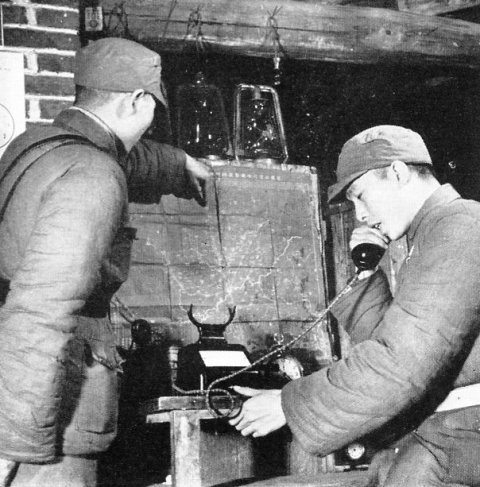 In air-defense outpost soldiers telephone warning to headquarters.
Chungking system is best in the world, has never failed to give warning long before planes arrived.
In air-defense outpost soldiers telephone warning to headquarters.
Chungking system is best in the world, has never failed to give warning long before planes arrived.
|
Like the supply problem, most of the Army Air Force's problems in China are the same ones Chennault had to combat with the A.V.G. There is a general lack of transport within China. Assembling bombs, ammunition and gasoline is difficult. Often bombs are moved by ox or horse cart. Gasoline is pumped by slow hand pumps. There are too few vehicles to transport personnel to and from the fields. Chennault is still operating with skeleton crews. Personnel must adapt themselves to local conditions. There is no Army kitchen police. Following after the A.V.G., the Army is using hostels and cooks supplied by the war Service Corps under General Huang, leader of Madame Chiang's New Life Movement. Espionage is no problem as it was in Burma but the Japs have a good alarm net and have radios within Free China so that recently, in an attack on Canton, the Japs had warning before the raid.
Almost every feature of operation is complicated by problems that are reduced to a minimum in the U.S. There are no good navigation aids. Chinese maps are used almost exclusively and often pilots have to guess at contours and rivers. Meteorological service is poor and planes run the danger of getting lost. The arrival of equipment, spare parts and personnel is slow. Lack of personnel always handicapped the A.V.G. and may hamper the Army too. In Rangoon the A.V.G.'s operated a squadron with a crew of 45 ground men whereas standard for the U.S. Army is generally over 100. No major repairs are possible for planes save at one base.
The A.V.G.'s never had modern hospitalization, They operated with four doctors, three nurses and a bottle of iodine. "We are just lucky that we are the healthiest bunch ever sent out here," say the A.V.G.'s who have not lost one man through sickness. The Army has sent more doctors, though they are still understaffed. I found one squadron without a doctor. All the American Air Force is in malaria and cholera country and there is need of more aid in the medical line.
The language handicap is a major problem. All telephone reports of Jap movements are in Chinese and come to Chinese who don't understand English and have to be translated by interpreters who aren't military men. Then the reports are put on Chinese maps. All this slows operations and is likely to result in occasional errors.
Personal problems are numerous.
The climate is uncomfortable, the food unsatisfactory and young aviators push
meals away in disgust.
"Every night, pork and potatoes and all the time cabbage, even for breakfast."
Mail is
slow.
"People responsible don't know how lack of mail affects us.
If I could get mail and late magazines I might
stay," said a A.V.G.'er who was leaving.
There is no recreation, no girls, nobody save their own gang to take the
men's minds off their work.
If the Army or some other organization would send mail and magazines and women
entertainers or nurses or War Service Corps workers out here instead of keeping them in camps at home,
the morale
of the fighting men, which is bound to be affected in an alien land, would increase 100%.
Chennault's genius makes an air force
Against these problems and many other heartbreaking ones of greater magnitude, Chennault today is opposing his own
individual genius.
In Chungking fighting it out on a political front, traveling in transport planes with a
dachshund named Joe, fighting it out on a tactical front against the Japanese and on a personal front with his
own men,
Chennault today, as for the past five years, is still obsessed with one consuming passion, to beat the
Japanese.
It is this intensity of feeling to which every other consideration is subordinated, to which every
detailed plan of action and to which every personal relationship is coordinated,
that has established this wrinkled,
scarfaced, half-deaf, 51-year-old ex-barnstorming pilot as the one genius that war on the Asiatic mainland has
yet produced.
His record is unequaled in the annals of combat aviation, a record established by pilots, ground men
and radio operators against thousands of an enemy air force that licked every other unit it opposed since Dec. 7.
Whatever else happens to Chennault, they can't take the record of the Flying Tigers away from him.
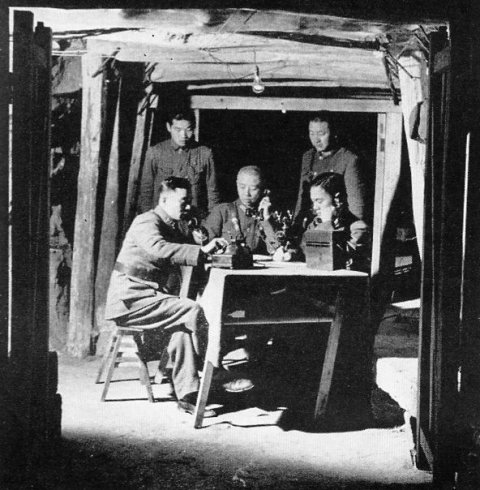 In headquarters near Chungking, Colonel Lu Che-sen (center) and two junior officers
of the Chinese Signals Corps notify the wardens and rescue workers to get to their posts.
In headquarters near Chungking, Colonel Lu Che-sen (center) and two junior officers
of the Chinese Signals Corps notify the wardens and rescue workers to get to their posts.
|
Bob Neale says the A.V.G.'s went into battle with such eagerness because the "Old Man" outlined a general plan and left details to the pilots: "Though he knew everything there was to be known about pursuits, he knew you were flying the ship and let you do it the way you thought best. That made for sunshine." When the A.V.G.'s first arrived in Toungoo the Old Man lectured them incessantly on his theories, gave them Jap bombs to study, told the men the good points of their own planes and the Jap planes, how to use one and avoid the other.
Chennault's personal interest in his men is proverbial. He always knows the idiosyncrasies of all of them. The Old Man never refuses to listen to the troubles of anyone. He personally saw that, after A.V.G. disbanded, every word of the fliers' contracts was carried out. When some A.V.G.'s exploded at what they thought was arrogance on the part of some Regular Army officers on the inducting board, Chennault passionately defended them and said they deserved a change and to go home. Then he began talking quietly to the men, assuaging wounded feelings and getting many who had who had planned to leave to remain. His abilities of persuasion are proverbial. I saw one Tiger who the Old man had persuaded to stay, shaking his head: "How he does it, I don't know. But once he starts talking you're lost."
His personal interest in his men extends into military operations. Just before the end of Rangoon, Neale's squadron was flying until the last minutes, operating without intelligence, not knowing where the Japs were. Neale, wondering when to evacuate, received a wire from Chennault saying: "Expend material to utmost. Conserve personnel. Retire when last bottle oxygen used." The A.V.G.'s only reason for staying is the Old Man. Adventure, pay, glory and rank don't influence them. "Yes, I'd sooner fight under Chennault than anyone in the world," a pilot told me, and others echoed him.
Chennault's organization was never vitiated by red tape.
It was probably the only military unit, with the possible
exception of the Russians, in operation without rank.
Since there were no officers there couldn't be any enlisted
men.
Chennault himself cares nothing about rank.
He told Neale: "I'd take a second lieutenant's commission if I
thought it the best way to carry on against the Japs."
He fights the Japs as he plays poker
The pilots said they never saw him mad except at the Japs and then this was cold, logical anger.
He fights Japs the
way he plays poker.
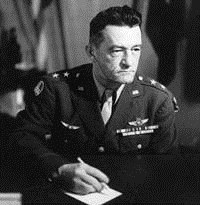 General Claire Lee Chennault, his men would rather fight for him than any other man in the world.
|
Chennault has eight children - six sons and two daughters. His oldest son, Jack, is commanding a squadron in Alaska. He and Jack are the only father and son who have ever fought in practice combat against each other. When asked who won, the General twinkled and said: "That is a military secret. But wait until the Japs run into him." After Pearl Harbor he cabled Jack specific instructions on how to beat the Japs. Jack passed the word among his buddies about Chennault's ideas on tactics and it is now spreading among younger officers in the air force.
Chennault is remarkable at improvisation, using materials on hand. Newly arrived bombers hadn't enough range so he put tanks on them, giving them an extra hundred gallons and an extra hour in the air. A gun position was found unsatisfactory and his men changed this, adding 20 m.p.h. in speed. This lesson is being cabled to the War Department and factories are changing their designs.
I have seen Army officers, who never met Chennault before, talk to him for a few minutes and come away saying, "That man's a genius." They say he has the best weaving pattern of defense that they ever saw. His tactics are unorthodox. He never fights war according to form but he produces results and in the end that is all that counts, as an increasing number of American Army officers are beginning to recognize.
Stilwell and Chennault are the only American or British generals I have met in Asia who I thought had any broad understanding of war and the only ones I have ever fully respected. Like every other general, Chennault has to fight the home front as well as the enemy. If Washington and London decide the main decision is to come in Europe and help is only to be sent to China as a political and moral gesture - and that is nearly all it has amounted to thus far - the American Air Force in China may be doomed. But if Washington makes up its mind without consulting Chennault, the margin of error will be tragically increased.
This is not a choral dance out here. This is a war. The A.V.G.'s and Chennault never cared for form or regulations and thought any method was correct that would insure an operation striking at the right time with all available means. Paper work was cut to a minimum. There was no waiting for O.K.'s from senior officers. Pilots did staff work. Brass hats in the Army poked fun at the lack of staff, but with what they had the A.V.G.'s did a hell of a good job.
Chennault is now getting a staff, and he has the beginnings of a damned good one. He's in the Army now and his problems are increasing. And, though he has never said so, I'm sure the only reason he joined the Army was because he could get more supplies and figured he could fight the Japs better within the Army framework than as head of a volunteer unit. If he didn't think this was the best way to fight the Japs I'm sure he would have found another way of doing the job.
Chennault is now on the crest of the wave.
His fame as an ever-victorious commander among a group of ever-defeated
Allied generals has spread around the world.
If America makes a big air effort in the Far East, Chennault undoubtedly
will rise to unprecedented heights.
But if America keeps any large air force out of the Orient then Chennault will
pass slowly into oblivion and with him will pass the whole American Air Force in Asia.
Chennault's ability stands
clearly revealed in the words of his own men:
"We would rather fight with Chennault than any man in the world."
It's a good slogan for the air force of the American Army.

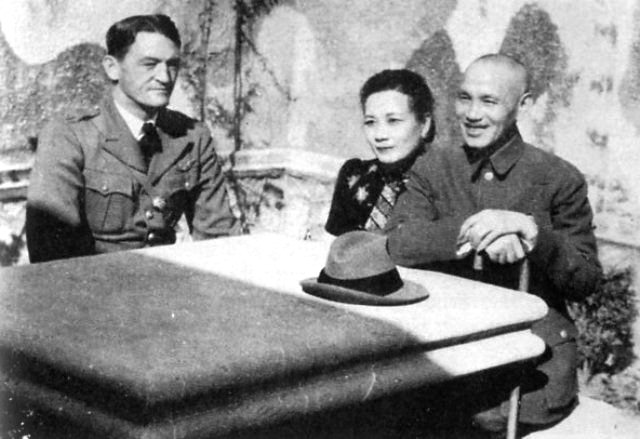 Chennault chats with Generalissimo and Madame Chiang Kai-shek at the A.V.G.'s old headquarters in
Kunming.
Building back of them is camouflaged against Jap raids.
Chennault chats with Generalissimo and Madame Chiang Kai-shek at the A.V.G.'s old headquarters in
Kunming.
Building back of them is camouflaged against Jap raids.
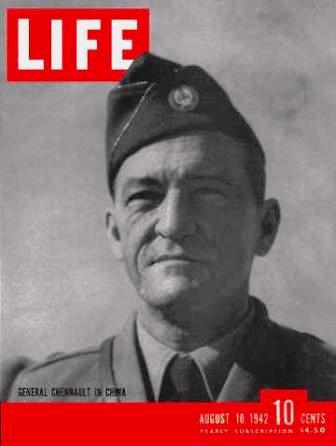 LIFE'S COVER: Brigadier General Claire Lee Chennault: born in Texas, 1890;
enlisted in Army Air Force, 1917; barnstormed around country in Army's flying circus, 1922;
retired because of deafness, went to China to plan aerial defense, 1937; commanded A.V.G., 1941;
made chief of U.S. Air Force in China, 1942.
LIFE'S COVER: Brigadier General Claire Lee Chennault: born in Texas, 1890;
enlisted in Army Air Force, 1917; barnstormed around country in Army's flying circus, 1922;
retired because of deafness, went to China to plan aerial defense, 1937; commanded A.V.G., 1941;
made chief of U.S. Air Force in China, 1942.
Adapted by Carl W. Weidenburner
from the August 10, 1942 issue.
Portions copyright 1942 Time, Inc.
Photos not part of the original article have been added
For private non-commercial historical reference only
TOP OF PAGE ABOUT THIS PAGE
MORE CBI FROM LIFE
CLOSE THIS WINDOW
VISITORS