|

 JUNE 30, 1941
At 2:30 a.m. we were routed out of our beds in a Hong Kong hotel and driven to an airport. By the strange light which lights all baggage rooms and places of departure, we shake hands without pilot, an American, tough, hearty, clean-cut. he tells us that one of the other pilots on the line was the inspiration for Dude Hennick, one of the heroes of Terry and the Pirates. Our pilot and the Dude and four other Americans run the most dangerous passenger airline in the world. Their four Douglas DC-2's and two DC-3's are one of the only two connecting threads between Free China and the outside world. The other is the Burma Road, still new and inefficient. The long route to Moscow is hardly a route to the world. Today there is only one DC-3 on the line because, the day before we finally left Chungking, one of them got its right wing bombed off by the Japanese just after it had landed its passengers safely at a small airport far up inland.
At 3 a.m. we take off on our five-hour flight in complete darkness - no lights in the plane and no smoking allowed. Pilot Macdonald zooms the ship up through the intricate hills of the harbor of Hong Kong where the lights of an imperial city still twinkle in rows. Soon all is black and we are over Japanese-occupied territory. In 40 minutes we pass to the right of Canton, the graveyard city where 1,000,000 Chinese have resumed living but there is no life and where Japanese pursuit planes are concentrated. As the sun comes up and the clouds clear, we look down upon a land of intricate and fairylike beauty. It is the land of the terraces of rice paddies and the land of thousands and thousands of hills, each hill terraced nearly to its top with rice paddies of infinitely varied shapes, some square, some round, but mostly like the sliver shape of the new moon, shapes within shapes until all but the wooded hill or mountaintop is full. It is the landscape which might have been dreamed by a child of pure imagination. The hills in Chinese paintings which seem quite fantastic are representative of those hills.
An hour passes. The hills become higher and broader-sloped and while the myriad shapes remain, they now become a great vastness of beautiful acreage of rice. We are in Szechwan, the province which has been an empire in itself. The fields are very wet. We are glad to see this. People in Washington, in the government of the world's greatest democracy, have been praying for rain in Szechwan.
Suddenly we see a place where two great rivers turn and twist in great circles, cutting the hills and coming together and flowing on, one river through the mountains to the sea. At their juncture is an old, old city - Chungking. The plane zooms low. We looked for bombed areas but our eyes pick up only what is, not what isn't. And we land below the hills in the middle of the river bed because the water has not yet risen above that convenient runway.
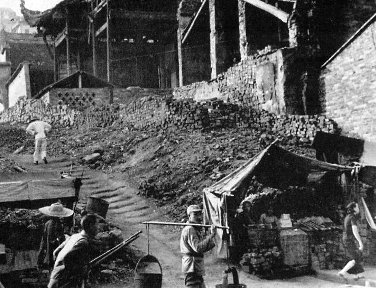 Chungking, Capital of China, has been bombed regularly, cruelly since September 1938. But the citizens go placidly about their business between the rubble and half-ruined buildings. |
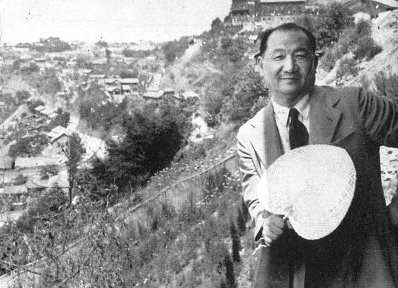 Dr. H. H. Kung, Minister of Finance and civilian Administrator, welcomed the Luces at his home. On hilltop behind is Kialing House, hotel for foreigners. Few days after this, a bomb shattered Kialing House. |
At Chungking we were met by a number of people and taken, first in chairs, up the steps of the city cliff and then, in an automobile, through streets which were utterly confusing because they were neither Chinese nor Western - to the house of Dr. H. H. Kung, head of the civil government of China. His home consisted of four rooms on each of two floors - the kind of home any missionary might have. Our reception was most courteous. The good Doctor Kung sat us down to breakfast. We had coffee and cream, both fabulous luxuries in Chungking. Later we had lunch on the other end of the dog-bone-shaped promontory which comprises Chungking proper, at Kialing House. Kialing is the name of the river which flows into the Yangtze. This river is blue and pretty until the rains come. We saw it muddy
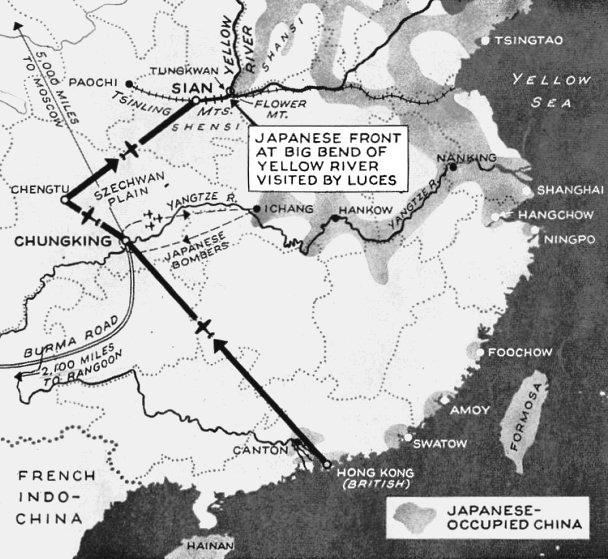
CLICK MAP TO ENLARGE |
I could make nothing of the city of Chungking. I soon discovered why. First, it had indeed been bombed but it took about a day to distinguish between the great masses of bomb-rubble on the one hand and, on the other, shacks, temporary structures and ordinary homes of the poor. Second, it no longer has the characteristics of an old-style huddles colorful Chinese city because a) great wide modern streets have been driven through it and b) many new "Western style" buildings have been built but they are all of gray brick usually smeared over with a little black paint. Along the wide streets are thousands of little Chinese shops, some old style, some new, but all open at the front. For the rest, the city is a mass of gray brick, some of the bricks being buildings and more just being bomb-messes. Through all this drab mess, millions of people (actually only about 600,000) streamed and rushed with typical Chinese excitement. There were thousands of rickshas - long rows of them laboring up or scuttling down the inclines of the street. Ten years ago there were probably not more than 20 rickshas in Chungking. Many of them came up from Hankow in 1938 and they are the worst lot of battered wrecks I've ever seen but ricksha coolies now earn much more than college professors and civil servants.
That night in his little dining room, Dr. Kung had some 20 people to dinner. Near me sat the famous General Ho, the Minister of War, theoretically the man next to the Generalissimo in military rank. Because he had risen so high through China's years of military conflict, I had thought of him as a tough guy. Instead I found him mild and soft of face and manner.
And so to bed under mosquito netting as the moon came up over the hills and the rivers.
We slept well at Dr. Kung's and had breakfast with coffee and cream. At 10 o'clock Teddy White and I were at the home of Foreign Minister Wang for a purely protocol call. At 10:30 we were on our way back, our car tooting its way through the bustling thoroughfare. Suddenly, Teddy said: "There's an air raid." I had noticed nothing but he had noted that a few people on the sidewalks had begun to run. Then presently I noticed that everybody was walking fast and that the open fronts of the little shops were being boarded up. When we got back home, everything was calm but the houseboys were in our rooms packing our suitcases.
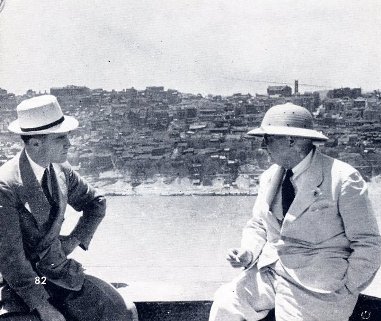 Henry R. Luce and U.S. Ambassador Nelson Johnson chat on parapet of Embassy. Now assigned to Australia,
Mr. Johnson has been succeeded in Chungking by Clarence Gauss.
Henry R. Luce and U.S. Ambassador Nelson Johnson chat on parapet of Embassy. Now assigned to Australia,
Mr. Johnson has been succeeded in Chungking by Clarence Gauss.
|
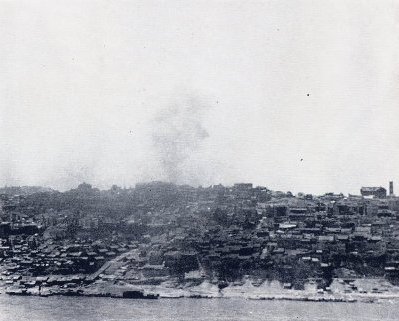 The daily bombing of Chungking is here photographed by Mrs. Luce from the American Embassy parapet. Japanese
bombs are just beginning to rain down haphazardly on the crowded city, half mile across river.
The daily bombing of Chungking is here photographed by Mrs. Luce from the American Embassy parapet. Japanese
bombs are just beginning to rain down haphazardly on the crowded city, half mile across river.
|
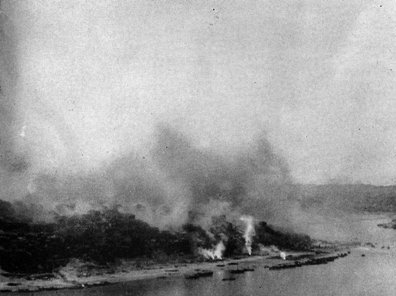 Fires break out quickly. Despite the inadequacy of Chinese anti-aircraft and plane defense, the cautious
Japanese bomb from 10,000 ft. Poor bombers, they haven't once in three years hit the vital powerhouse.
Fires break out quickly. Despite the inadequacy of Chinese anti-aircraft and plane defense, the cautious
Japanese bomb from 10,000 ft. Poor bombers, they haven't once in three years hit the vital powerhouse.
|
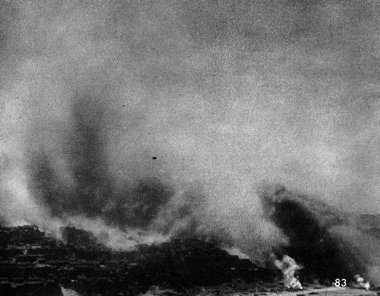 The fires smoke up and go out in 15 minutes as firemen get into action. Though water often has to be carted up
from the river by coolies, Chungking's fire fighters are very efficient.
The fires smoke up and go out in 15 minutes as firemen get into action. Though water often has to be carted up
from the river by coolies, Chungking's fire fighters are very efficient.
|
As soon as possible we got into the streets again. By this time the whole town was trekking. The street between Jung's entrance and the top of the cliff overhanging the river was crowded with people from the poor quarter which surrounds his home on the "downtown" section. Everybody had a bundle. Lots of the bundles were babies. Bigger children walked along quite serenely. As we turned the corner we came to a place where an orderly stream of humanity was pouring down a hillside. As we turned into a main street, the traffic paced insistently. Horns tooted. Trucks and crowded buses churned up the dust.
By this time the first siren was blowing, meaning that the enemy planes, having left Hankow an hour before, were now entering Szechwan province. They might or might not come to Chungking: that would not be known until the second siren in another half hour or more. We had an appointment for lunch at the American Embassy across the river. One of Dr. Kung's secretaries who was assigned to us wanted to go straight to a dugout. He would lose enormous face if anything happened to us. Nevertheless, White knew we had plenty of time and so we made our way circuitously down to the ferry on the riverbank.
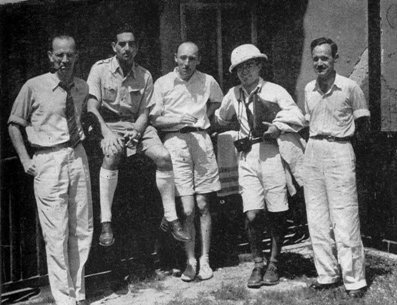 The press in Chungking lines up. L to r: F. McCracken Fisher, United Press; Melville Jacoby, N.B.C.; F. T. Durdin, N.Y. Times; Teddy White, TIME and LIFE; Maurice Votaw, Government publicity adviser. |
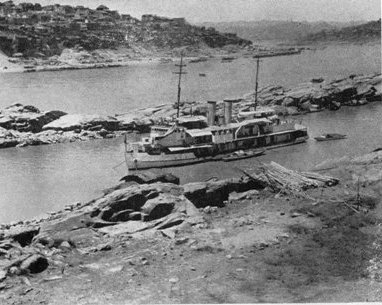 The U.S. Navy in Chungking is represented by the small gunboat Tutuila, which anchors in a little rock harbor on river across from the city. On June 15, it was spattered by bombs. |
A swank-looking launch, probably impressed by our official car, consented to shoot us across the Yangtze but when we got to the other side it refused to take us a mile or so downstream to the Embassy landing. The launch shot back to the other side and we were left on a wide sandy river shore. Then a very polite guard began to move us back farther up the sandy shore. Then another guard signaled us even further back. And then White said, "Hey" and, sputtering with delight, told us the Generalissimo must be coming.
And sure enough, two launches swung into the dock - a big one first, from which 20 blue-gray plain-clothes men leaped and took posts along a path up to where two sleek cars were standing. And then from the smaller launch, which had ferried us, stepped a slim figure of a man in a black semi-uniform suit, wearing a sun helmet. He walked with lithe methodicalness, putting his black cane down determinedly at every step. As he walked, he lifted his sun helmet and then we could see him nod his head once and pass on to his car.
When the Generalissimo nods his head - with or without the two syllables cui ("can-do") - it is the biggest Yes in all of China. When he shakes his head it is an implacable No from which there is no appeal. And the Yes or No are given instantly - the very split second the last words of the proposal have left the petitioner's mouth. A minute later we were dashing down-river in the launch of the greatest ruler Asia has seen since Emperor Kang Hsi, 250 years ago.
As we sped down between the towering hill-banks of the river we could see, on the Chungking side, orderly riverlets of people moving into the caves. At the Embassy landing Major McHugh met us, a little bewildered by the launch we had come in and the direction from which we had come. We got into sedan chairs. But first we noted, hid in a curious harbor of rocks just big enough for it, one small flat-bottomed U.S. gunboat - the American Navy farthest west.
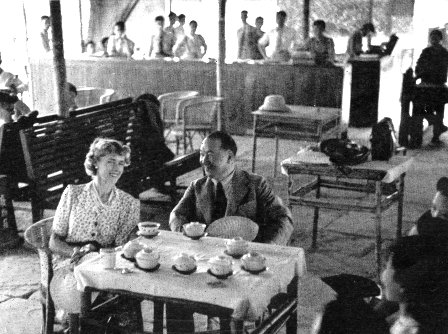 At the Chungking airport, Mrs. Luce and Dr. Kung have tea while a committee of Chungking ladies, whose covered tea cups are on the table, sit beaming at the right. There was a wait of three hours for the transport plane back to Hong Kong, the Japanese having chased and disabled the regular plane on the previous day. |
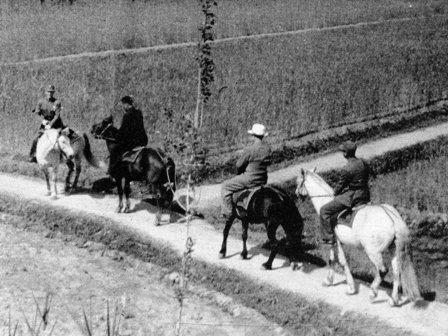 Through the wheat fields near the Yellow River, Mr. Luce rides behind General Chow and Hollington Tong, government official who accompanied him on his trip to the front. The road is unusually wide for this part of the country. Most of the roads are very narrow. They hamper the motorized movement of the invader. |
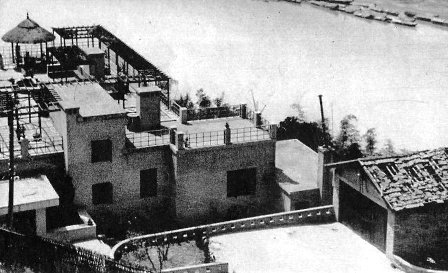 T. V. Soong's new house has never been seen by its owner, China's financial wizard, who was sent to Washington last year before his house was built. Very important guest like Roosevelt's emissary, Lauchlin Currie, stay at the Soong house. |
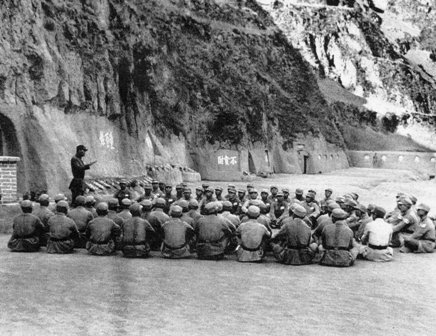 At the camp near Tungkwan, soldiers gather for political lesson which is considered as important as military lesson. Chinese characters on wall spell out motto for men: "Do not desire money," "Love thy people." |
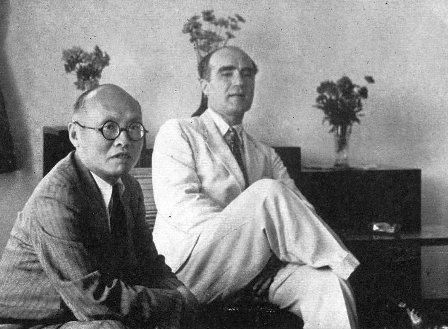 Mr. Luce meets an old China friend, Communications Minister Chang. |
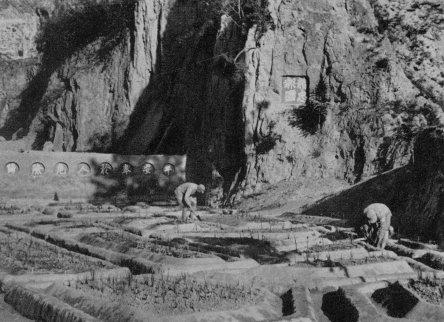 Soldiers build up the irrigation ditches for the vegetable garden in front of their barracks. |
At the Embassy, way up the hill, Ambassador Nelson Johnson and the Embassy staff greeted us and we went to the terrace wall and looked out over the river at Chungking. The sun was high and hot and the whole scene now lay in an amazing stillness. No creature could be seen. No sound could be heard. All the junks were tethered to the shore and no air stirred. The Ambassador chatted about previous raids - how that section over there - "see it, the big empty patch on the hillside" - had been cleaned out by fire. The majors pulled out their watches, looked up into the dazzling sky and listened expertly. May 3 and 4, 1939, were the unforgettable days - the first big raids. At least 5,000 people had been killed and untold thousands wounded. Thousands more had been killed that year and in 1940. But now the people of Chungking know what to do. They just fold up their town, boarding up their shops, storing away their valuables and themselves into the caves. Not more than 100 would be killed today - not unless a very bad fire was started.
"There they come!" I could hear nothing nor see anything except the blazing sky. Then: "Corrump, corrump, corrump, corrump." And Again: "Corrump, corrump, CORRUMP." And then a mighty wall of smoke a mile long burst up from just behind the crest of the long city-hill. The majors were pointing into the sky and then I saw, flick, flick, flick, the little shiny flicks of silver mackerel scales. Yes, six, twelve, yes, there were more and then more. The corrump-corrumps were over in a minute - the smoke, dirt-dusted smoke, mounted and spread. And it was quiet. The Major said there were 42 airplanes. And then suddenly - it seemed just below us - C O R R U M P - sputter - spatter - corrump-corrump - siss-bang sputter corrump - just on the bank of the river across from us where the junks were tethered and up along the sand and a little way into the shacks on the cliff a hornet's nest of incendiaries mixed with high explosives had been dumped. The phosphorous candle flames of the incendiaries burned gold-red in the sunlight. The smoke spread.
"Yes," said the Ambassador, "it looks like they'd started a fire in those shacks." But slowly the flames burned out on the sand, and the smoke spread no more. The smoke of the first much bigger bombing was now nearly gone - only a few dusty blotches remained over the skyline of the hill. And we waited and had our pictures taken against the lessening background and asked questions and were told many things from the long three-year history of the bombings.
When we got back to the city, we wanted to see what damage had been done. Along the main road we saw a small house or shop knocked out here and there and people already busy in the mess of bricks, putting the bricks in piles and salvaging wrecked pieces of furniture. The whole city was alive with traffic, busier than ever. The columns of air-raid wardens, which we had seen marching to work three hours before, were now marching back through crowded streets. Presently we turned into the spacious compound of the Methodist Mission and there, right in the exact center of its biggest open field, was a huge new crater and all over the field for 50 yd. were lumps of new-thrown mud.
We went over the field to the hospital. The capable-looking Chinese doctor said he had received twelve cases - and pointed to a little blood that had not yet been mopped up from the floor of the receiving room. But all was quiet. The business was over. One old man, the doctor said, was expiring up in the ward. Total casualties that day were 40 dead and as many more wounded. There is not much sympathy for the victims now because it is felt it is mostly their own fault for not going into the dugouts. But it was a bad day for precious automobiles, for which there are not yet quite enough dugouts. I saw two horrible wrecks on my way up the highest hill in Chungking to the British Ambassador's. And when on the summit of Chungking, I turned into the Ambassador's driveway, there were two more mangled remains of autos.
Sir Archibald Clark Kerris, as everyone knows, not only the most charming white man in China but also, in the opinion of many, the ablest diplomat. An aristocratic Scotsman, he is a power for liberalism. The house he occupies, resembling a large pergolaed teahouse, was built by admirers for the Chiang Kai-shek's but they rent it to Sir Archibald, the rent going to the Warphans. Sir Archibald showed me where two or three bombs had dropped around his pergola and where the plaster had fallen and then sitting on his terrace we had a two-hour heart-to-heart talk on the state of China.
That night we dined with the Foreign Minister, a distinguished pundit who was once on the Hague Court and is now retiring from the Foreign Office. The personalities of the evening were the dynamic storytelling Mayor of Chungking and his wife. Mayoress Wu is the standard of Chinese beauty - small, petite, her face a flawless oval. Also, her little mouth speaks excellent good sense.
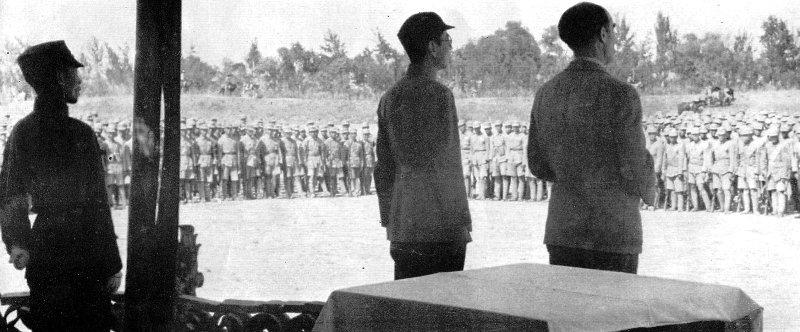 The soldiers of China lined up near the northern front to hear a greeting from Henry Luce whose words were
translated by the officer standing beside him. A committee of soldiers had presented Mr. Luce with a message of
esteem for the American people, for President Roosevelt and for democracy. Soldiers are wearing shorts which is not
typical of the Chinese Army.
The soldiers of China lined up near the northern front to hear a greeting from Henry Luce whose words were
translated by the officer standing beside him. A committee of soldiers had presented Mr. Luce with a message of
esteem for the American people, for President Roosevelt and for democracy. Soldiers are wearing shorts which is not
typical of the Chinese Army.
|
The bombs came again the next day. This time we took them from the inside looking out. About 9:30 White was working with us on cables and schedules when a houseboy came in to announce quietly, "First ball." The enemy planes had left Hankow. Servants set to work packing up everything in the house and we were soon on our way to the other side of town to the dugout of Dr. Kung's Central Bank of China. A long flight of steps led down from the road above to the bank building and to the dugout behind the building. On these steps 30 or 40 people began to gather - those who had tickets for this particular dugout. An American, a very handsome fellow in khaki shorts, was sitting on the steps further down. He was William Hunt, the outstanding high-powered sales representative in China of nearly every U.S. product.
The sun rose higher and finally the second siren sounded the "urgent" and we all left the steps and went down under, past a few guards into a tunnel. Eventually we found ourselves seated in a big, underground room crowded, but not uncomfortably, with Chinese clerks and their families. One section was reserved for us, Hunt & Co. and several Chinese whom we had met. Talk went around for half an hour, bets were taken on how near the nearest bomb would be and then suddenly there was complete silence in the entire dugout and evidently those with sharp ears could hear the enemy. BANG - CRASH - BANG - HELL. For 30 seconds the noise was terrific and then it was all over and after another half hour we all went out into the dazzling sun.
The bomb-attack's main force had come on the same path as the main salvos of yesterday - a path over the high hill of the British Ambassador's and on the slopes where most of the cabinet ministers live in modest new houses. This day the fanciest new house in Chungking was completely demolished by a direct hit - the house built with loving care by Sun Fo, only son of the late Sun Yat-sen. The Central Bank building in whose dugout we were, got a bad shaking and one bomb dropped precisely above where we were sitting. But it was a dud - they say about 20% are.
As we came up the steps from the dugout and on to the main road, who should come whooshing by but Mayor Wu - inspecting the damage in the best LaGuardia manner. He stopped only long enough to say "hello" and raced on. This day it seems more were killed - perhaps 100 casualties all told. Why? Same reason, they said - they had waited in the sun outside the dugouts just one second too long.
That day we had our big appointment - tea with Madame Chiang, and possibly, The Man Himself. The Madame in the flesh is an even more exciting personality than all the glamorous descriptions of her. After her striking entrance into her large, dimly-lighted living room we were in almost no time at all talking 100% American faster than I have ever heard it talked. Talk flowed on and then a door opened and a man came, unnoticeably, into the room. For a moment or two the talk continued. And then, suddenly, you get the feeling that there was no person in the room except the man who had just entered it so quietly. We stood up. A slim wraithlike figure in khaki moved through the shadow and there were a few distinct grunts of encouragement:- "How . . . How . . . " ("Good . . . Good . . . ") The Madame introduced us. Now there was pleasure and hospitality in the grunts - and a smile on the thin mouth: "How . . . How," he said, motioning us to be seated.
He inquired about our journey, expressed his gratitude that we should have come so far to see his people. We replied briefly and the Madame explained a good many things seemingly to his pleasure. Food was served - good, simple food which is what I like best in China. I showed him a portfolio of photographs of himself and Madame and leading personalities of his Government. He grinned from ear to ear and was as pleased as a boy with the pictures of himself and Madame. He looked at each photograph very quickly but the pictures of men in his Government who were not really important, he passed without looking . . . An hour later we left knowing that we had made the acquaintance of two people, a man and a woman, who, out of all the millions now living, will be remembered for centuries and centuries.
In the three days at Chungking it had been established as absolute fact that I could not get to the front in the short time we had. I told the Generalissimo, through his hard-pressed interpreter, Hollington Ting, that I wanted just one thing - to see his Army. For half and hour his little pinhead black eyes had been burning into me. Now, the second he heard the request, his head nodded. Cui, cui, can-do - can-do, the Yes-Law of China. And then he paused and I think he was calculating the location of every airplane in China. Cui - Can-do. And when we went down the steps of that house, the good dark-brown face of Hollington Tong was full of wonder and excitement.
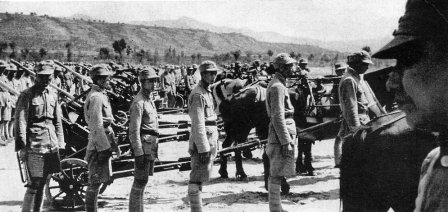 Guns in such numbers as this are rare in Chinese Army. Only crack divisions can muster so many pieces all at
once. These combination anti-tank anti-aircraft guns are 20-mm Italian Bredas. China's own armament factories are
beginning to produce in respectable quantity.
Guns in such numbers as this are rare in Chinese Army. Only crack divisions can muster so many pieces all at
once. These combination anti-tank anti-aircraft guns are 20-mm Italian Bredas. China's own armament factories are
beginning to produce in respectable quantity.
|
When the black clouds became less threatening, we were summoned to the runway in the river bed. There in that great river chasm stood what looked to me like the world's smallest airplane - a Beechcraft, the back seat done in green leather. We shook hands with the Captain Pilot Yang. And off we went up into the broken clouds over the folding hills of Chungking. The plane rode well. Captain Yang was good. My wife sat up in front with him. "Holly" Tong sat back with me and at 8,000 feet, went to sleep.
In no time at all we had passed over 100 miles of rolling rice country and the mountains had begun. They are called the Tsinling Mountains and very beautiful they were. There was also a great many of them. When we reached that last and highest range (12,000 ft.) with clouds gathering over them in the late afternoon, Pilot Yang decided suddenly that there were too many to cross in one day. He turned back, heading for Chengtu, capital and biggest city of the "Empire" of Szechwan. After an hour the mountains got lower and presently we were scudding over the Szechwan plain, a vast flatness of lovely rice fields 100 miles long and 50 miles wide. At twilight we landed on the Chengtu military airport, after Captain Yang had with incredibly steep banks circled half the city to notify everybody that we had unexpectedly come to town.
Early next morning we were off again over the rice plain toward the mountains. On the northern side, they seem to drop sheer to the illimitable plains of Shensi. There is no more rice now, only wheat, beautiful miles of golden wheat ready for harvest. And no longer are farmhouses separately surrounded by rice paddies. Here the famous village life of North China begins. A village is 100 to 1,000 houses and courtyards under trees, for each home has its big tree, and nowhere else on the plain are there any trees except at the temples. And then straight ahead we see the endlessly long wall of a great city. It is Sian and we are circling the airfield. Down we come, a good landing, but the plane skids. We catch our breath. Yang has the plane at a stop. We hop out, a platoon of soldiers runs towards us and we are bundled breathless into a car. The car races toward the city but sharply turns up a country road. Finally we understand there's an air-raid alarm, and a few minutes after landing in the Beechcraft, we are squatting in a wheat field, the wheat high. Throughout the field we have neighbors and companions, not only farmers but people who have hurried out from the great city to crouch or stand an hour or more, not too close together, in the golden wheat. Meanwhile our car has been parked in a shallow ditch, a brown tarpaulin thrown over it.
But we do not wait long, for presently they decide the enemy is probably not coming to Sian and we are off in the car again. We still do not enter the city but go instead to an ancient Buddhist temple courtyard not far from the East Gate. A pagoda rises tall in the center of the courtyard. Nearly all the beautiful tiles of the Tang Dynasty which made it a flame of color on the brown plains are gone, but even in naked brown clay the pagoda, once a library of monks, is beautiful.
This courtyard is now the headquarters of the Commander in Chief of the northern armies, General Hu. During three years the Japanese have gained scarcely a yard on that great Northern Front, whose defense is managed from this temple. Notably the Japanese have been unable to cross the Yellow River. The Japanese are now attacking at various points along the river and elsewhere on the curving Northern Front. A few days before they tried a crossing at the big bend of the Yellow River, at a town called Tungkwan where we are going. The Chinese claim they sank hundreds of Japanese in rubber boats trying to cross the yellow flood.
General Hu is not at headquarters - he is somewhere up at the front. We are received by his intelligent-looking young chief of staff and taken out of the hot sun up into a cool upper room of one of the temple buildings behind the pagoda. We have had no lunch and little breakfast. The chief of staff provides tea and excellent biscuits. Then he expounds to us a detailed map of the military position for 100 miles. Presently, an unusually snappy young officer reports. He is presented to us and it is at once clear he speaks American with the greatest of ease. This is Lieutenant Chiang, in command of a platoon of 50, one of the two sons of the Generalissimo.
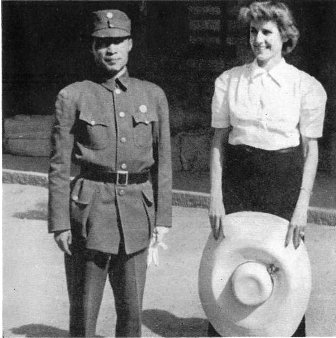 Mme. Chiang gave Mrs. Luce a big hat which she carried when she met General Li of the First Division. This division was in reserve, 40 miles behind Yellow River front. |
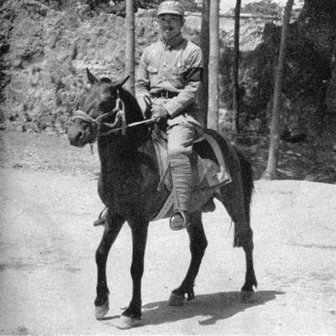 General Chow, on his Mongolian pony, commands 167th Division at Tungkwan. His is only one of the many divisions commanded by General Hu, headquartered at Sian. |
We wanted to have a good look around this vast and famous city of Sian, ancient capital of the Han Dynasty, the cradle of Chinese civilization. But first we must go call on the Governor of Shensi. His residence is very unassuming - an ordinary Western-style brick building in an unimpressive courtyard. His name is Chiang, the same as the Generalissimo's, and interpreter Tong brings to him a note from the Generalissimo. It is traditional for the rulers of China to be good calligraphers and the Generalissimo's bold characters are evidently much prized.
Our call was pleasantly perfunctory and soon we were free to wander about the great city. Very little so far as we could see of its ancient splendors remained. So ignorant are we of Chinese history that we do not know under what upheaval of dynasties its beauty was submerged. What strikes me about these far inland cities is how modernized they have become. They would never remind any newcomer of St. Louis or Des Moines and yet I see America and the 20th Century stamped all over them: wide long straight streets with sidewalks and young shade trees planted;
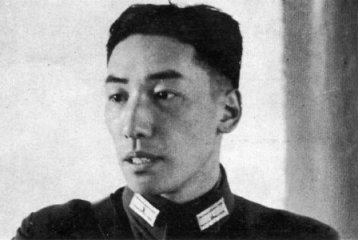 The Generalissimo's son, Chiang Wei-kuo, is a second lieutenant stationed at Sian. He was a student in
Germany, came home by way of the U.S. last year to join the Army.
The Generalissimo's son, Chiang Wei-kuo, is a second lieutenant stationed at Sian. He was a student in
Germany, came home by way of the U.S. last year to join the Army.
|
The Governor of Shensi and Madame Chiang had us to dinner - small as most Chinese dinners are but lots of food. The Governor's chief of cabinet was a man from Shantung, the province in which I was born. In his discourse (English) he seemed to be making some apology for Hitler so I thought it proper to speak very harshly to my fellow provincial.
At 11 p.m. we went to the station. The station is a beautiful highly colored Chinese-style building - one wing nearly gone as a result of bombing. This railroad runs straight across the middle of North China from Paochi some 100 miles west of Sian right straight for 600 or 700 miles to the sea in Shantung. The Chinese control it from Paochi for 200 miles east of Sian and in that direction we were about to go. And toot-toot, we were in and off.
Until after midnight we chatted with our two or three official companions, particularly a young London School of Economics graduate, now a major general of the political division of the 34th Army Group. Then to sleep. At 3:15 a.m. Hollington Tong pounded on our door. We had arrived in the night at the front.
The automobile which was to take us from the railhead to the front line came up on a flat car on the train with us. Generals at the front in China do not have staff cars. They have to ride fast-jiggling Mongolian ponies.
It was darked when we sped through the little railroad town and deliciously cool. Dawn began to break as we came out on the plain. With the sun we could see close by on the right Flower Mountain which the Chinese long since agreed is the most beautiful of all their many mountains. All day long we were never out of sight of that purple mountain.
Soon another mountain, a long rangy one, rose in the distance before us - for the moment a more interesting one because this mountain was on the Japanese side of the Yellow River (which we could not yet see). Fighting is going on around the mountain and a 100-mile battle for the Yellow River is developing.
At 5:10 a.m. we arrived on the slope of a small loess hill and got out of the car which we laid away under tarpaulin. (All this countryside is loess - powdered dust, the oldest earth in the world.) The air was clean and cool. Outside a farmhouse on their threshing floor a farm family was already working. We rounded the farmhouse on a narrow path and came in view of a drill ground just like the threshing floor only a little bigger. A company of troops was being drawn up. They came to attention, the band played, the officers saluted - but not for their general. They saluted a flag far above them on the hilltop, a flag waving in the dawn for the Republic of China. Then the troops were marched off on the double-quick and that was the most troops we saw at one place all that early morning, though 12,000 of them were all about us beginning at that little headquarters village and extending to the water's edge of the Yellow River six miles to the north.
We were at this moment visiting the 167th Division of the Chinese Army. There are in all about 300 divisions - more than 3,000,000 organized soldiers, not counting trainees. (By some calculations the total of the Chinese Army is brought up to more than 5,000,000 and probably there are 5,000,000 Chinese in some kind of uniform and with some kind of
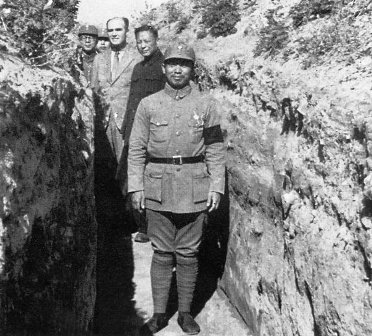 At the Tungkwan front, General Chow, Hollington Tong and Henry Luce walk down a narrow communications trench
up to the front lines on the bank of the Yellow River.
At the Tungkwan front, General Chow, Hollington Tong and Henry Luce walk down a narrow communications trench
up to the front lines on the bank of the Yellow River.
|
weapons.) Of the 300 divisions, between 100 and 150 are still spoken of, at least unofficially, as "provincial" - i.e., divisions which still do not or cannot obey all the rules and regulations of Chiang Kai-shek. These "provincials" may still divide their loyalty between Chiang Kai-shek and some provincial war lord or ex-war lord. But starting four years ago with only about 50 divisions of "his very own," Chiang Kai-shek has now "nationalized" at least 150 and perhaps 200 divisions.
The 167th Division was, of course, a regular "national" division. Whether what we saw of it was typical of the rest of the national army we cannot say, but to judge from comparatively few white men who have visited other parts of China's 2000-mile battle line, the 167th is apparently typical. And, if so, let it be said right now that the Chinese Army of Chiang Kai-shek has a fine morale, as strict discipline, as earnest and as intent an expression as ever characterized any army in history.
Whether or not the generals of the 150 or 200 "good" divisions are better or worse generals than General Chow, commanding the 167th, we cannot say. General Chow was small and muscular. His leggings were tightly bound around enormous calves. His footwear was the straw sandal of the troops. His shoulders matched his calves. His uniform was drab khaki without the smallest insignia of rank. But on one arm he wore a black band and since it is also a Chinese custom not to shave while in mourning, he had a few long hairs where a mustache might be and the rudiments - or the wreck - of a goatee sticking out of his chin. Withal, he was from the first moment quite clearly a soldier and a gentleman.
When the flag had been hoisted and the troops marched off, he took us into a mud-house reception room. Tea and biscuits were served, with infinite politeness, around a big table. A few orderlies and one or two officers came and went with quiet speed and discipline. General Chow put before us a few maps drawn with brilliant clarity on poor paper. These disclosed to us in its entirety the military position of his little sector of China's vast front. Machine-gun nests here and there, trench mortars here, eight big gun emplacements so - and the enemy was drawn up thus and so.
After tea, the General said we must take a look around the village. A most amazing place. At short intervals there were deep ravines in the loess cliffs. Each ravine was a company barracks. One such ravine-barracks we inspected in detail. The floor of the ravine, all made of dust, had not a speck of dust showing. Where there was space for a vegetable patch, something had been planted and a few soldiers were at work in the gardens. Along the company street small trees had been planted. The General first took us halfway up the bank to the latrines. He was proud of them; you cannot see them; that was the trick; to cover everything over with a pile of earth and a little lime. We went into the caves - each cave bedding about 15 soldiers. In each cave a writing table and a bookcase - in all about 100 books. In front of one of those caves 50 soldiers sat in a circle listening to a lecture on political science.
General Chow bounced along happy and pleased and proud, leading the way and never bothering to do any polite Chinese bowing. Then he showed us a number of the mud houses in the village - two right at the entrance of the company street, which his soldiers had built fine and new for the peasants. "We build them the houses - on condition," he said "they keep clean." They were certainly clean that morning - the cleanest things in China.
At the end of the village, a small troop of cavalry seemed to be assembled. Our party mounted Mongolian ponies - the meanest little runts I have ever seen. We went off in single file, through the village gate, the General leading, but before he could grasp the situation, my wife's beast had run off with her into a field and caused her to drop a camera. We were on our way to Tungkwan, the walled city on the river's edge. The six or seven miles were cluttered with traffic - donkeys, wheelbarrows, etc. - supplies for various units of the division. We went through two or three large villages. They were crowded with people and the food shops piled high with produce. Between the villages here in the valley bottom it was mostly truck garden.
Presently we caught sight of the river and then it was lost to view again behind the walls of Tungkwan - walls which ran up the hills on either side in the manner of the great wall of China. We dismounted at the city gate and, to the obvious alarm of the subordinates, the General led us up intricate side streets to the high railroad embankment and bridge which cut through the town. Then we could see across the river to the high cliff on the Japanese side. There, about 1,000 meters from big Japanese guns, we could see the piles and piles of rubble along the embankment, but the tracks still ran straight out of a tunnel and across the town.
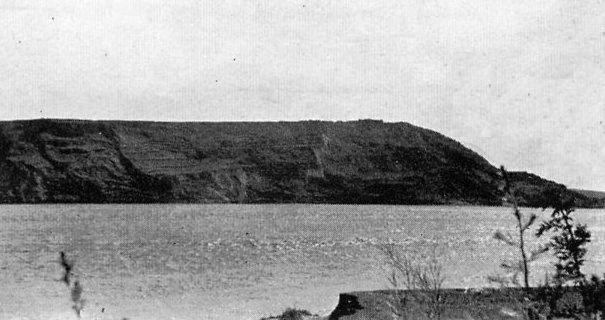 At the Yellow River China's Army faces Japan's troops, entrenched on hill across the water. Once flood-ridden
China's sorrow, the Yellow River is now her great bulwark.
At the Yellow River China's Army faces Japan's troops, entrenched on hill across the water. Once flood-ridden
China's sorrow, the Yellow River is now her great bulwark.
|
The General led us through the town which had quite obviously taken a terrible pasting. Acres of what were once mud houses lay in dreary ruin under the rising sun. Finally we came to the wall of the city nearest the river and the Japanese. Just on the inside of the wall the Colonel of the front-line regiment met and showed us about his headquarters. He had made a flower garden out of a rubble mess. The Colonel took us into a dugout and gave us tea at a dining room table. There were flowers on the table and on the side table. Then we mounted the wall - from the inside, of course, and this time when we got to the top, the General rather wanted us to keep our heads down below the parapet. Between the wall and the river was about 800 yd. and then it was about 1,000 yd. across the river. We could see clearly the twisting lines of the 167th's trenches and the locations of its machine gun nests.
As we went through the huge river gate of the city wall, we were submerged at once in the trenches. On our way out to the farthest point, we stopped in two machine gun nests. Soldiers were reading. We stopped for a translation of one little book, a primer which began by explaining that every good soldier must learn to read. Finally we were at the outpost and a few yards from us the mighty torrent of the Yellow River made the great arc of its famous "bend." On the cliffs beyond we could see the gun emplacements and then we spotted one Japanese sentry and through the glasses we could see the flag of Nippon.
That was all. Furiously rushed to see the Hwang Ho and quiet was the day. We turned back through the horribly bombed city. At the outskirts of the city our car miraculously reappeared and we traveled a couple of miles to view a heavy gun emplacement in a village. The gun crew went through the routine and it looked very snappy.
At this point General Chow and one aide mounted their Mongolian ponies and we set off with them riding behind us. In the country road, they easily kept up with us. We let them get ahead to avoid the dust. A path between the wheat fields turned off from the road. The General waved us one last farewell and turned down the path toward his headquarters. The last we saw of little General Chow on his little Mongolian pony, he was going hell bent for leather - and for victory.
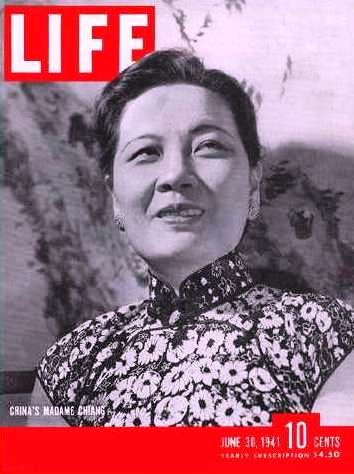
LIFE'S COVER: Mme. Chiang Kai-shek, whom Henry R. Luce and Clare Boothe Luce met and admired in Chungking,
is in a very real way as much a warrior as her Generalissimo husband. Mme.
Chiang (pronounced "jahng") works with
wounded, cares for homeless "warphans," helps guide all-important industrial co-operatives, directs all women's
activities. She never ducks a job because it may be dangerous. For four years, from Nanking to Chungking, Japanese
planes have been after Mme. Chiang. But they have never caught up with the charming indomitable woman who has become
a martial inspiration to her beleaguered country.
Adapted by Carl W. Weidenburner
from the June 30, 1941 issue of LIFE.
Portions copyright 1941 Time, Inc.
FOR PRIVATE NON-COMMERCIAL HISTORICAL REFERENCE ONLY
TOP OF PAGE PRINT THIS PAGE ABOUT THIS PAGE
MORE CBI FROM LIFE MAGAZINE CLOSE THIS WINDOW