China-Burma-India Theater 1945
The only decent cup of coffee in India, GIs will tell you, is to be found at the India Coffee House in New Delhi, just off Connaught Circle on the shady side of the street at breakfast time. There in the comparative cool of a summer morning you hear stories of the early mad and exciting days of the CBI.
|
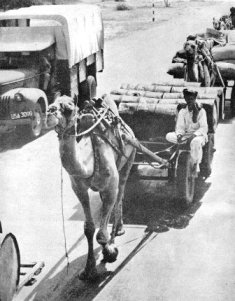
CBI... China-Burma-India Theater... was a hodgepodge, a vast and sprawling conglomeration of everything in the world spread over a large part of the world's largest continent. There anything could happen and usually did if you only waited a little while. There Air Forces and Ground Forces and Service Forces performed vast feats of endurance and of skill, lost battles and won campaigns, retreated to victory, paid a hundred dollars for a pack of cigarettes, drove camels harnessed to primitive wooden carts with modern rubber tires, learned that the movies don't know how to pronounce "sahib."
It's different now - or is it? There is no more CBI. There's the India-Burma Theater. There's the China Theater. The Hump, the vast mountains which divide India from China, still stand forbiddingly across our supply route and separate the two theaters just as they used to divide one. To the south and west, India still is India. On the other side of the mountain China still is China. On both sides, American soldiers each day perform impossible tasks and push the war closer to its conclusion.
From the beginning, the CBI Theater had two main purposes. It opened the air supply route over the mountains to the Chinese armies and at the same time built the Ledo-Burma Road around the ranges. Second, it served as a base for air operations against Japan. Although on several occasions American troops took part in land fighting against the Japs in Burma, that was principally a British show.
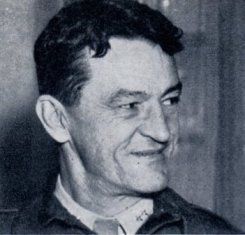
But it was American flyers who struck our first blows at the Japs in Asia and they were not at that time a part of our regular military establishment. Leathery, two-fisted Captain Claire Chennault had retired from the Army in 1937 to become a special air advisor, with rank of colonel, on the Chinese staff. In 1941, with 100 obsolete P-40B planes and a reckless crowd of young American adventurer-flyers, he formed his famous Flying Tigers, officially known as the American Volunteer Group. They left San Francisco five months before Pearl Harbor, landed at Rangoon just before Christmas the same year.
|
The next July, Chennault's group became the American Army's China Air Task Force. At the same time we organized a similar force in India. In March, 1943, another change of name occurred. The Chennault outfit became the American 14th Air Force.
No matter what it was called, it had two principal functions and it performed them magnificently. First, it was to "contain" the Jap air strength in China, as the military men phrase it. By being aggressive and nimble, by striking hard and getting away fast, it kept a considerable number of Jap military planes so busy on the continent that they could not be used in the island war. The second purpose was to bomb Japanese troop concentrations and transportation on the mainland and adjacent islands. The American flyers in India, now called the Tenth Air Task Force, meanwhile tried to protect the workers on the unfinished Ledo Road.
When the Japs cut the Burma Road and occupied practically all of Burma, Chennault's squadrons had to depend wholly on air transport for gasoline, ammunition, spare parts and food. The dangerous route over "The Hump" from India became the project of our Air Transport Command.
The supplies flown over The Hump in January, 1944, totaled 13,399 tons. The next January, with more planes operating that treacherous route than there had been commercial airline ships in the whole United States before the war, the lift amounted to 43,896 tons. In May the figure topped 50,000. But even that wasn't enough to furnish our own air crews what they needed to strike with all their strength against Japan. It left practically nothing for the Chinese Army.
Fireside strategists here at home had complained loud and bitterly because we weren't arming the Chinese fast enough. The fact that we armed them at all, cut off as they were from the rest of the world, is surprising. The American Army was not blind to the potential ground forces in China. Early in the war it began to plan to assist the Chinese Republic in equipping and arming as many divisions as possible.
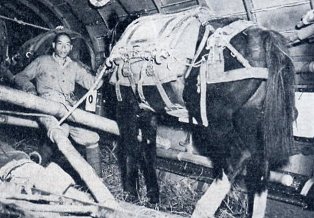
No matter how many munitions and supplies we had in India or the pacific, we could deliver them to China only by air. The Japs were sitting in all the Chinese ports. They held Thailand, Indo-China and Burma on the south. There was no practical land route through Siberia. And on the west a mighty range of mountains, rising as high as 17,000 feet, presented a baffling obstacle.
|
That left us two hard choices. We could fly in some supplies or we could drive the Japanese out of northern Burma and build a land route from India. We did not have enough planes then, never had had enough, to carry to the Chinese troops all they needed. Every ton of gasoline we flew into China for our own Air Forces, cost three tons of gasoline to transport it by air. Besides, we had no suitable air fields in India for a lift of the size required.
We could, and did, fly in the gasoline for our bombers stationed in China. We could, and did, fly in the basic equipment for some thirty Chinese divisions. We even sent a few baby bulldozers by air. We sent a few jeeps. But trucks, tanks and large machines needed a land route. In other words, we had to build a road.
Most of the Burma Road had been overrun by the enemy. The port of Rangoon and the railhead at Mandalay were in Jap hands. Only the upper reaches of the road, near Kunming, were free. If a Chinese force with American aid could push southward from there, clearing the upper reaches of that road, and we could push a new highway from the valley of the Brahmaputra to meet it, we should have a truck route to Chungking.
In 1942, at the obscure town of Ledo on the border between India and Burma, we set to work. The obstacles we faced at times seemed insurmountable. The delays were heartbreaking. We had to fight mountains, rapid rivers, jungles, disease, floods, monsoons, fearful heat... and Japs. We had to fight the calendar and the clock.
While we worked, Chennault's 14th Air Force kept right on whittling at the Japanese. The people of America never knew the heroic efforts of that little band of valiant fighters so far from home. As an example of their striking power take the 36 days ending July 5, 1944.
| In those 36 days Chennault's men, thirsty for gasoline, begging for more and more bombs, destroyed 900 Japanese river boats and destroyed or damaged 60 Jap planes. They blew up 817 enemy cars and trucks, smashed 32 bridges on strategic highways valuable to the Japanese, sank 139,000 tons of enemy ocean shipping. They killed or wounded some 14,700 Jap troops. In addition, they found time to drop 583 tons of ammunition and supplies to isolated Chinese forces. |
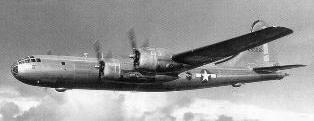
To China, meanwhile, had come another air force. It was the now famous Twentieth and it was not under the Far Eastern Command. Rather, because of the high strategy of its operations it reported directly to General Arnold
|
Starting with small raids in small numbers, the power of the 20th Air Force has grown rapidly and Japanese cities and munition and aircraft plants lie in ruins because of its fearful destructive power.
But the big planes need greater quantities of gasoline, oil, repair parts, bombs, supplies for the crews. For each B-29 a compliment of twelve officers and 72 enlisted men, aloft and on the ground, must be housed and fed, clothed and given medical attention. A fleet of 100 Super-Forts requires the labor of enough men to make up half an infantry division.
The CBI Theater grew swiftly with Quartermasters and Engineers, transportation forces, Signalmen, Ordnance companies and Medical units swarming in.
In the early days of CBI, New Delhi was the headquarters and the Queensway in that sparkling, brand-new city became Main Street to many thousands of surprised Americans who never had expected to see India.
Our first port was Karachi on the Bay of Bengal in the northwest corner of the country. Although it was a long way from the future battlefront it also was far from the danger of Jap ships and planes.
| Karachi lay on a mud flat beside its artificial harbor with its dock line sprouting a hundred tall cranes. The Liberty ships along the quays seemed always to draw in their skirts from the ancient and shabby dhows that staggered back and forth, each with its smoky fire of camel dung on deck. Karachi port reminded the soldiers who had been in Africa of Casablanca harbor, it was so new and clean; West Coast GIs glanced seaward across its narrow channels and thought of Los Angeles. |
Through this modern port could pour a vast amount of military tonnage. But behind it, beyond the overflowing warehouses, the railroad began, and that was another story. The troop trains and the cargo trains pulled out to the east, toward the valley of the mighty Brahmaputra, nearly two thousand miles away. In that distance the road changed gauge several times and all freight had to be unloaded, stacked, guarded against pilferage, loaded into other dinky cars, and shunted on. It took a Service soldier, on his way up to work or fight along the Ledo Road three weeks or four, to make the trip across the hot Central Plains of India. The Joes looked out of the windows and saw Hyderabad and Jodhpur and Jaipur and sometimes the noisy crowded railroad station at old Delhi. The train halted in a place called Agra and the saw glistening domes surrounded by temporary scaffolding.
| "Taj Mahal... how d'you spell it?" "Remember the World's Fair in Chicago, Joe?" They weren't impressed. They would have preferred Cedar Rapids or Bangor or Dallas as a train window view. The discovered the Indus and the Ganges and ancient gilded tombs of saints and princes, but give them the old Missouri, any day. |
The Ledo Road had its real beginning not in Assam Province where the first bulldozers went to work, but in a quiet room on Constitution Avenue in Washington one afternoon in August, 1942. The Army Engineers, after studying the maps, told the Combined Chiefs of Staff they would try the job. There were Japs in some of the valleys they had to cross but they'd meet that problem when they came to it.
Ship after ship, loaded with equipment moved across the Atlantic, around South Africa, up the long reach of the Indian Ocean and the Arabian Sea. Then came the train journey, the delays, exasperating and heartbreaking by turns. There came the local customs to be met or somehow got around, leisurely customs among a people who had seen many wars in a thousand years and were not going to let one new war change their pace or their ways. We built our warehouses, we built railroad yards and hospitals; we strengthened bridges, we built as we went. And at the last the sultry Brahmaputra lay at our feet.
The Joes had learned a lot by that time, about weather and diet and snakes and insects and religion. Most of them were perfectly willing to respect any man's religion and most of them did. But sacred cows seemed somehow more than some men could bear. To good American farm eyes they weren't even good farmyard bossies and the provost marshal had his hands full in the eternal war on the highways between sacred cattle that would not move aside and jeeps and trucks that were in a hurry.
The Ledo Road plan was to push south and west from Assam Province, over the hills and swamps and up the tall ranges through the best grades we could find, to bridge the rivers, drain off the surface water, and somehow, in as short a time as possible, join the old Burma Road for the run into Kunming.
|
Our Engineers, guarded by Chinese Infantry, began to bore through the jungle. They found the going hard. The sick list grew as the malaria country got worse. The monsoon came and flooded out our workings, and the heat came and struck down our men. And the Jap came, occasionally, and had to be chased away.
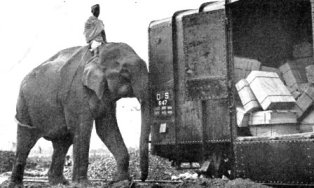
We started a motor barge line on the Brahmaputra; we took over the sinuous Bengal-Assam Railway. American railroad battalions of the Transportation Corps ran the trains, men from the Pennsylvania and the New York Central, from the Northwestern and the Southern Pacific and the Santa Fe. They found outworn small engines and rolling stock, toy trains compared with American lines. They learned to use elephants as switch engines and to be patient over delays.
Then as the British under Admiral Lord Louis Mountbatten of the Southeast Asia Command finally began to get the upper hand of the Japs in Burma, the American railroaders needed more locomotives, and needed them fast, in order to press the advantage we had.
| Eighteen engines, meter-gage, gasoline-driven, weighing when crated 12,000 pounds each were flown from Plymouth, Ohio to Burma. |
The Ledo Road pressed forward. Pipelines were carrying gasoline now from Calcutta, first a four-inch line, then a six-inch line beside it, then still another four-inch line. The six-inch line runs only as far as Myitkyina, where our transport planes fill their tanks for the hop over the ranges. Only one four-inch pipe reaches all the way to Kunming. The pipes save thousands of trucks which can be used to haul ammunition and food instead of gasoline.
|
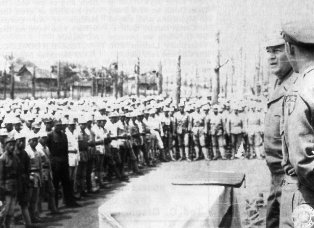
General Stilwell's Chinese-American forces drove back the Japs repeatedly in those early months of the Asiatic war. His army consisted of five Chinese divisions, trained by American officers and fed American rations, one American combat task force of about the strength of a brigade and a small number of British troops. These and the Engineers whose job it was to build the road. And the Signal Corps, laying telephone line, and the Medical units and the rest of the Service soldiers. The Chinese troops are tough fighters. Those who were fed American rations gained an average of 25 pounds in a few months. They learn to use modern arms and equipment rapidly.
The Japanese continued to infiltrate into our lines. General Stilwell, who had marched out of Burma nearly three years before, after taking what he admitted was "a hell of a licking," had a very personal reason for wanting to put the road through. He just didn't like Japs for one thing and he wanted to give them the same kind of licking they had given him, with compound interest. Unless he was able to push the road through, he'd never be able to win.
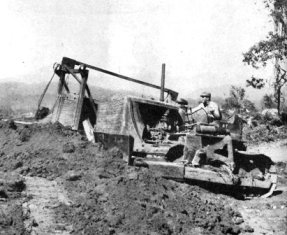
On the Ledo Road the bulldozers came first. They reversed the old military tactics. It used to be that the truck trains and heavy machinery stayed far behind and the Infantry cleared the way. But on the road to China the bulldozers were out in front, protected only by a small covering party of foot soldiers.
| Many a bulldozer driver died at the controls. Jap snipers in the jungle picked them off repeatedly. So GI ingenuity went to work again. The drivers themselves built steel bulletproof cabs against which Jap bullets pinged and on each bulldozer was mounted a machine gun to pay back in kind. Thus the Engineers pushed forward, fighting and digging, digging and fighting, mile after hot and weary mile. |
When General Stilwell was called home to command the Ground Forces he had the satisfaction of knowing that the Ledo Road would be finished and the further satisfaction, before he returned to the Pacific to command the Tenth Army, of hearing the highway officially designated the Stilwell Road.
CBI meanwhile had been split into two separate units, the China Theater in the northeast and the India-Burma Theater to the south. Lt. General Daniel I. Sultan was named American commander in India-Burma and Major General Albert C. Wedemeyer was assigned to China.
The men who built the road, who ran the railroad, who handled the difficult supply problems in that far corner of the world, deserve more credit than they ever will get. There was Major General Raymond "Spec" Wheeler, for example, who commanded the Services of Supply, and whose accomplishments were beyond the most hopeful dreams. There was Major General W.E.R. Covell, who succeeded Wheeler and finished the job brilliantly.
There was white-haired, picturesque Brigadier General Lewis A. Pick, who did the actual bossing on the road and so endeared himself to his men that in spite of the official name, to them it was "Pick's Pike."
There was Brigadier General Paul F. Yount, who had made the Iranian State Railway one of the most efficient in the world. He was called out to Burma late in 1943 and he broke the bottleneck on the railroad there and hauled more tonnage than our most enthusiastic predictions had set as maximum.
There were the obscure majors and captains, sergeants and privates, negro and white, who built a monument to their own courage and spirit, there in the drenched jungles and on the mountainsides.
|
The road pressed on. To the Japs who had laughed at the effort, who twitted our troops on the radio, begging them to hurry construction "so we can walk into India," must at last come the realization that here was something beyond the understanding of the Oriental mind. Here was the impossible being accomplished... but fast. We had no centuries as the ancient Chinese had to build their famous wall. We had no years. We measured our advance not by yards and months, but by hours and miles.
The Ledo Road went forward over much of its twisting length at the rate of a mile a day. That was impossible, sane men who know engineering will tell you soberly. Sane men will say that what was done just can't be done. But this isn't a sane world in the jungles of Burma and over the steep gradesof the mountains up China way. The progress those men of ours made, working day and night, was fantastic. And the highway they built was a good, solid road.
The tonnage that had been pouring into Karachi was beyond the wildest dreams of steamship men. It came off the ships too fast for the Indian State Railway to handle it. Then came Calcutta. No one expected much of Calcutta. The native dock labor wasn't the best, the port facilities didn't promise a great deal. The British had used the port to supply some of their Burma army but the tonnage had been comparitively small. The Japs were closeby; bombing would have been easy.
We took over Calcutta because we needed extra tonnage closer to the front. Anything we landed there would be velvet. At first we were disappointed. The port had a hard time getting out of its easy going ways. The native labor couldn't get excited about the war.
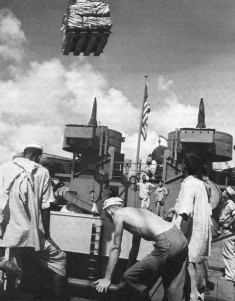
But there was a slow-talking, lazy-acting major general over in Cairo who in his quiet way had done the impossible
on several occassions and General Somervell suggested that he be assigned to Calcutta to see what he could do.
He was a one-time national guardsman from Georgia named Gilbert X. Cheeves and he said goodbye rather relunctantly
to his friends in the Middle East, picked up his cactus swagger stick and went to India.
|
When the new road over the mountains to China met the Burma Road, it opened the door the Japs so long ago had slammed shut. It opened too, a new prospect for the far eastern war. Even before any tonnage began to pour through this gap to China, Japanese forces were starting to shift their positions. They could see what lay ahead if they persisted in holding all their ill-gotten gains. The Air Forces caught them on the run and blasted them, and the thirty Chinese divisions, finally supplied with American basic equipment, chased tem northward along the coast and drove them out of positions they had held for nearly three years.
But the work of the China and India-Burma Theaters was not all road building and railroading and flying. The British finally got enough men and enough arms and ammunition on hand to start the long drive into Burma, and the Japanese resistance crumpled before Mountbatten's men.
Even before that, American Army units in the jungle had performed feats of stupendous heroism. The glider landings in small clearings behind the enemy lines, the exploits of Merrill's Marauders, of Cochran's Raiders, Stilwell's own heroic fight... these all are part of the pattern of the war in Asia. There's a book longer than this whole volume in all of them, in every company of every regiment, in every squad of every company.
Together, the Air Forces, the Infantry, the Artillery and Engineers, the Signalmen and Medical Corpsmen, the
nurses and the Ornance crews, the Transportation Corps railroaders and river boatmen, the fighting Quartermasters,
all did their part to make the bright patch of the old CBI a thing of pride.
Excerpted from THE MIGHTIEST ARMY by Colonel Karl Detzer, General Staff Corps., U.S. Army, 1945.
Adapted for the Internet by Carl Warren Weidenburner. Copyright © 2005.
Portions Copyright 1945, Karl Detzer. Page Revised: 05/15/2025
TOP OF PAGE ABOUT THE MIGHTIEST ARMY MORE CBI THEATER